Archive for the ‘Calendar’ Category

PATAH ELIYAHU

Wednesday, May 21st, 2008

From Reb Zalman’s 1994 Elat Chayim shiur, “The Next Rung,” Reb Zalman discusses the Patah Eliyahu which you will find below along with Reb Zalman’s translation. Happy Lag B’Omer! Gabbai Seth Fishman, BLOG Editor.

“The Patah Eliyahu is taken from the Tikuney Zohar and is the first point in that book which references the ten S’firot. The Sefer Y’tzirah talks of ten S’firot, but they are a different set than the one here in Patah Eliyahu. So this is the first source of the ten S’firot to which Kabbalah makes reference.

“The author of the Zohar has heard the secrets from the prophet Elijah of how God emanated ten S’firot. The implication is that if one hears it from the prophet then it is a transmission of truth. 

“In any Siddur which has been influenced by Kabbalah, the Patah Eliyahu may be found in a T’filah Kodem Hat’filah / a preparation for prayer in the beginning of the book, and/or before the Minha service on Friday afternoon.

“Once the S’firot are seen in the body, one understands them. As an idea alone, there’s no understanding. In the body, it becomes clear how a thing is held.”
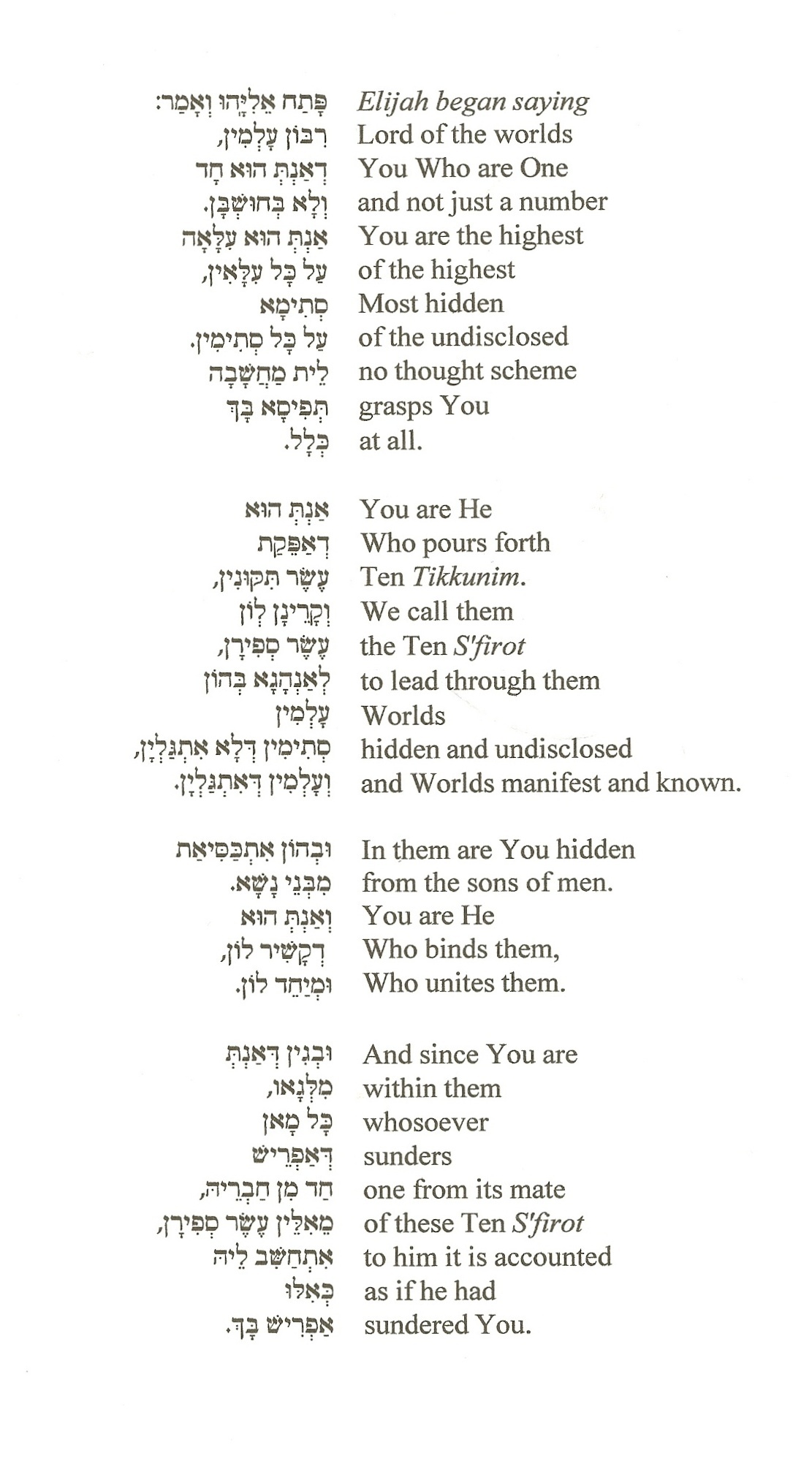
 

(more…)

An Affirmation on the Tree of life

Wednesday, May 14th, 2008

I found the following piece by Reb Zalman in 49 Gates of Light: Kabbalistic Meditation for Counting the Omer, by Rabbi Yonassan Gershom.  Rabbi Gershom reprinted this from the B’nai Or Newsletter 1983 issue. 

I affirm the power of positive affirmations.
I affirm that the Shekhinnah surrounds me and blesses me.
I affirm the lightbeings in G-d’s service who support and guide me.
I affirm the blessings of Abraham and Sarah in my life.
I affirm the sacrifice of Isaac and G-d’s power over my life and death.
I affirm G-d’s holiness and my growth toward it.

I place my Self under the protection of the Sephirah of Keter which will shield me from all harm and neutralise it.
I invoke the flash of Hokhmah to align my intellect to clarity and purposefulness, to inspiration and realisation.
I invoke the care of Binah to lead me to G-d’s heart.
I invoke the abundance of Hesed to bring me to atonement.
I invoke the power of Gevurah to see me through trouble and lead me to redemption.
I place my Self at the compassionate heart of G-d’s Tif’eret and affirm the healing, balancing and integrative centering light within me.
I support my Self on the pillar of Nezah channelling to me all manner of blessing and prosperity, and place it at the disposal of the redeeming Messiah, unfolding to witness the Shekhinnah‘s residing in Zion.
I support my Self on the pillar of Hod, making order in my life, gathering all the forces from dispersion and settling them in the blessed Jerusalem where I offer my thanks to G-d’s glory.
I base my Self on the foundation of Yesod to act righteously and justly, to assist all righteous effort in the world and to become peace-full to work for peace.
I affirm that Malkhut, the Shekhinnah, is the one offering these affirmations in me and is attracting the flow of blessing to suffuse my life.

Sefirot: In the Presence of God

Saturday, May 10th, 2008

The following excerpt explains why it’s so important to make the Sefirot / Divine attributes real for you.  As you count the Omer this year, keep this teaching in mind.  The excerpt is from Reb Zalman’s 2003 Shiur “Inner Space” given at Elat Chayyim, and available on the  DVD Set called “The Space Within,” which you can obtain from Aleph.  Gabbai Seth Fishman (BLOG Editor)

There’s a special thing we have as Jews and that’s the notion of covenant  …  The torah tells us that we are children of God.   It says, in effect, our dna matches that of the Ribono shel olam / God [lit. Master of the World].  We are also asked to enter into a covenant with God.  A covenant must have two sides to it, i.e., our commitments to God and God’s commitments to us.  

We chant on Rosh Hashonna and Yom Kippur:  Ki anu amecha v’ata malkenu / We are Your people, You are our ruler.  There is a relationship between us and God.   We’re connected.  A kind of relationship comes out in the liturgy because underlying this is a root metaphor that we have. 

Watch this expression, “Root Metaphor.”  It’s an important one.   It means a metaphor somehow deeper than our ways of thinking, and also deeper than our ways of feeling.  The root metaphor was established in us and it included a kind of relationship with God, a covenant, and that business of relationship is what is so essential to defining our Judaism. 

In the Jew-God relationship, there is this chutzpadike moment, infinite arrogance almost, when we say that we can make a deal with God. 

And I like the way it says in the book of Devarim, “ani heemarti … atem heemartem” / I have bespoken you …  You have bespoken Me (Deut 26:18, ff.)  You get the idea:  Bespoken, i.e. addressing, one to another.  And the Latin translation of the Hebrew really helps out here, because it shows me something still deeper about the root metaphor which goes like this:  What’s the Latin root for speaking?  diction.  And what’s the Latin root for speaking to, addressing, bespeaking someone:  ad diction

So the chumash is telling us, that God is saying, “I’ve become addicted to you; you’ve become addicted to Me.” That’s a sense that I like, davka, about addiction. 

(more…)

Haggadah: Telling and Empowering

Tuesday, April 8th, 2008

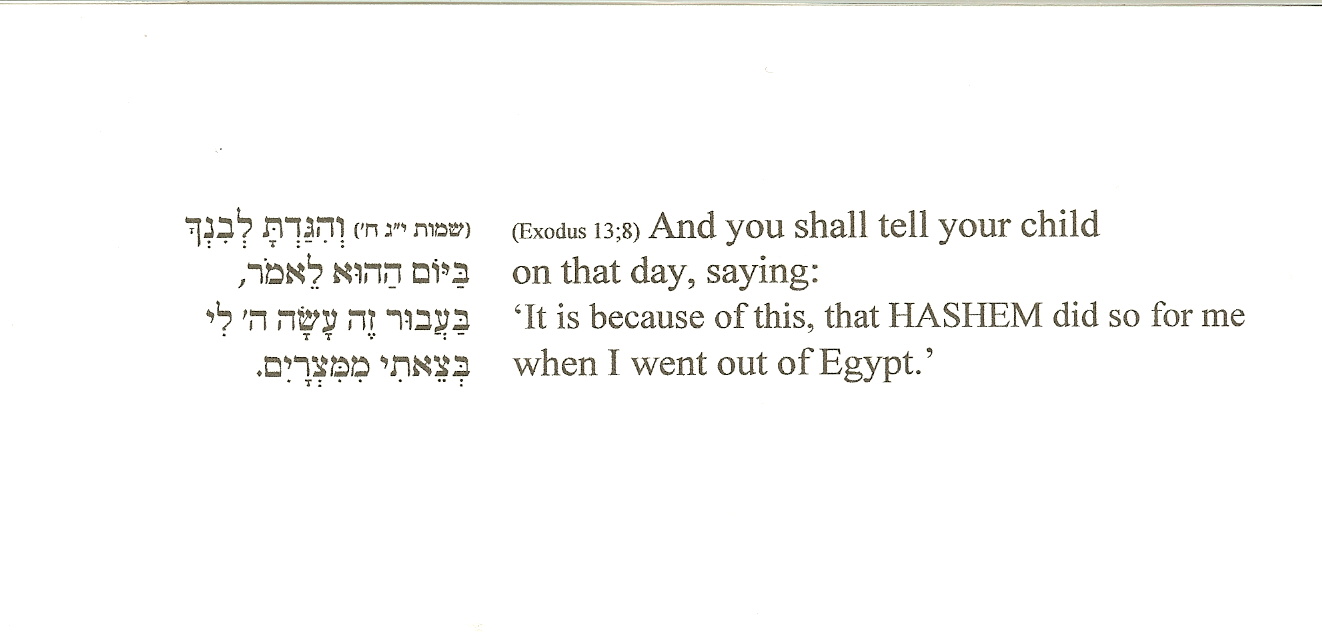
The following text is one of the four times the Torah asks us to be sure there is a telling of the Exodus from Egypt to our children. 

l-vincha.jpg

From the above text plus the three others, the Rabbis had the idea of Four Sons of the Haggadah

The Rabbis were Piscean New-Agers, and in those days, they read bin-cha as “your son.”  That’s how they understood it.  Instead of “your son,” we read it as “your child,” the Four Children

In Hebrew, the word “children” can be either Yeladim / young boys and girls, or Banim / offspring (of any age).   When the word bin-cha occurs in the Torah, the “children” refers to the latter usage, i.e., child of any age, offspring.  

It is also understood to mean the child within oneself. 

So at the Passover Seder, we must speak about Exile, Pessah, Deliverance, Faith and Healing with our sons, our daughters and the child within ourselves.

While the Seder speaks of four kinds of children, we can also say there are four kinds of parents who answer:  1) the body, 2) the feeling spirit, 3) the intellective soul, and 4) the intuitive God-spark in us.  What a blessing to give voice to all these four and to open these four in our children. 

(more…)

Pharaohs of the Environment

Tuesday, April 8th, 2008

We are the Pharaohs of the environment,
And we live in the time of the current plagues

A kavvanah for the Marror

Blood, frogs, vermin, …, goes the catalogue of the plagues of Egypt.

Polluted earth, water and air, —  goes our catalogue —, Ozone holes, Acid rain, Argon gas, meltdown, genetic flaws, dead rivers and lakes, dying oceans and extinct species.

We are the Egypt; and we are the Pharaohs whose hearts have been hardened and who refuse to let our Mother, the Earth, heal.

We must shout a Dayyenu — Enough – No More! to that — and begin to act.

I feel ashamed as I look at the seder plate, its signs of life, the egg, the green, the salt water of the seas.  It all tastes bitter, and the Charoseth does not sweeten it enough.

As we are fastidious about the laws of Pessah, we must become fastidious about what is helpful to Earth, and like Chametz on Pessach, we must avoid what destroys her.

Chad Gadya‘s domino effect is no longer funny. The Angel of Death is at the penultimate end.

We must redeem it with two Zuzzim we must move-zuz from our present way to a new and eco-redeeming way. 

     by Rabbi Zalman Schachter-Shalomi     (Pessach 5749 / 1989)

Toward Freeing the Seder

Tuesday, April 1st, 2008

The Passover Seder celebrates our being freed from slavery.  Yet, we are sometimes enslaved by rigid notions of how the Seder must be run.  Please consider Reb Zalman’s suggestions as you plan your Seders during the next few weeks.  I wish you all a suessen PesachGabbai Seth Fishman (BLOG Editor)

TOWARD FREEING THE SEDER

By Rabbi Zalman Schachter-Shalomi, Ph.D.

Table of Contents:

Introduction
Rechatz / Hand Washing
Die Vier Kashes / The Four Questions
Avadim Hayinu / We Were Slaves
Enslavement to Dualities
Freedom and Mishpocha
Two Seders
Esser Makot / 10 Plagues
The Fast in the Feast
Sheloshah Devorim / The Three Things
Pesach / Passover Lamb
Baking Your Own Matzah
Matzah: The First Taste
Three Matzahs: Three Sets of Jews
Breaking the Middle Matzah
Three Matzahs: Chochmah, Binah, Da-at
Maror
Maror: Bitter Work
Maror: Somatic Connections
Shulchan, Nirtzah / Meal, Acceptance

Introduction

I am here to free you from the Maxwell House Haggadah, to free you in your Pesach celebration! 

One thing that’s wrong with widely-used Haggadahs is archaic English like “vouchsafe,” or “bestow.”  This kind of language makes it hard for us to understand even the of-this-plane plagues of the Egyptians, e.g. what is “murrain?”  And the instructions are wooden.

Why? Because at the time when these Haggadahs were edited, people wanted specific directions, a definite, “Amy Vanderbilt” description of precisely how one was to do it.  They weren’t interested in being free to play, to elaborate.

But you are not just free to use better Haggadahs, (the ones with good translations and more openness), you are also free to use the material as a jumping-off point for playing, for elaboration.   Like the Siddur, the Haggadah is a kind of a cookbook filled with recipes.  You can’t eat a cookbook, even ones with the tastiest, the most nourishing recipes.  You must do the cooking to turn recipes to dishes.  And it’s similar with the Haggadah:  You make the words three-dimensional, four-dimensional.  Every Seder you have is a different way to bring the words off the page with different “spices,” different life-conditions.  Here are some notes toward freeing your Seders:

(more…)

Psychic Cleaning for Tzoris

Tuesday, March 18th, 2008

Here’s another piece from Reb Zalman’s Yishmru Da’at work, from the section on Purim.  Blessings to you and yours, Gabbai Seth Fishman, BLOG Editor

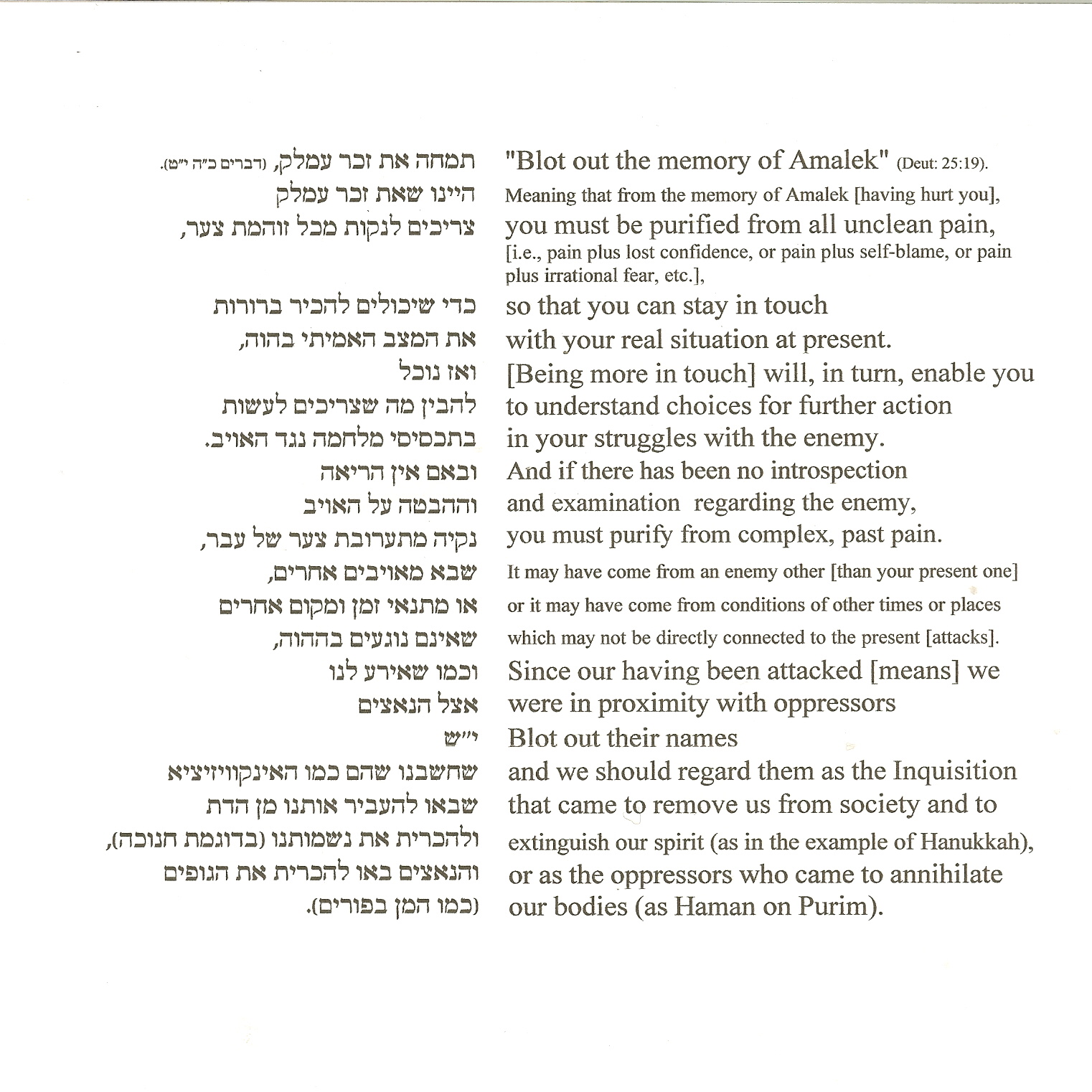
“Blot out the memory of Amalek” (Deut: 25:19),
meaning that from the memory of Amalek [having hurt you], you must be purified from all unclean pain, [i.e., pain plus lost confidence, or pain plus self-blame, or pain plus irrational fear, etc.], so that you can stay in touch with your real situation at present.  [Being more in touch] will, in turn, enable you to understand choices for further action in your struggles with the enemy.  And if there has been no introspection and examination  regarding the enemy, you must purify from complex, past pain.  It may have come from an enemy other [than your present one], or it may have come from conditions of other times or places which may not be directly connected to the present [attacks].  Since our having been attacked [means] we were in proximity with oppressors, blot out their names, and we should regard them as the Inquisition that came to remove us from society and to extinguish our spirit, (as in the example of Hanukkah), or the oppressors who came to annihilate our bodies, (as Haman on Purim).

purim2.jpg

Replacing Doubt With Clarity

Saturday, March 8th, 2008

This is a translation of the first section on Purim from Reb Zalman’s book Yishmru Da’at available from Aleph.  The Hebrew text is found after the English below.  Happy Purim.  Gabbai Seth Fishman, BLOG Editor

“Remember what Amalek did to you…  He chilled you on the way – put you down…  When [God] will grant you rest…  Blot out the memory of Amalek… Don’t Forget.”  (Deut 25;17,18,19)

“Blot out the memory of Amalek…”  That is, no memory of Amalek shall remain with you.  And at the same time, “Don’t forget?”  It’s strange.  How can we remove our memory of him and yet not forget him?  Why it’s a contradiction!  A paradox that can’t be understood on face value.  And so it raises safeq / doubt regarding this commandment.

How to explain? Like so:  Amalek in numerical value is safeq / doubt.

70 (ayin) + 40 (mem) + 30 (lamed) + 100 (kuf) = 60 (Samech) + 80 (feh) + 100 (kuf)

And what main doubt [is Amalek’s legacy]?  In everyone, there is a deep-seated urge for self-destruction, to sabotage oneself, stemming from [the angel’s] strong arguments [as to why mankind should not happen], and Azael, and as written in the section on Yom Kippur in the Sefer Beit Yaakov (Izhbitze).  This accusation [against mankind] is found in the Christian “Original Sin,” the sin of the Tree of Knowledge.

(more…)

Al Hanissim / For the Miracles

Monday, November 26th, 2007

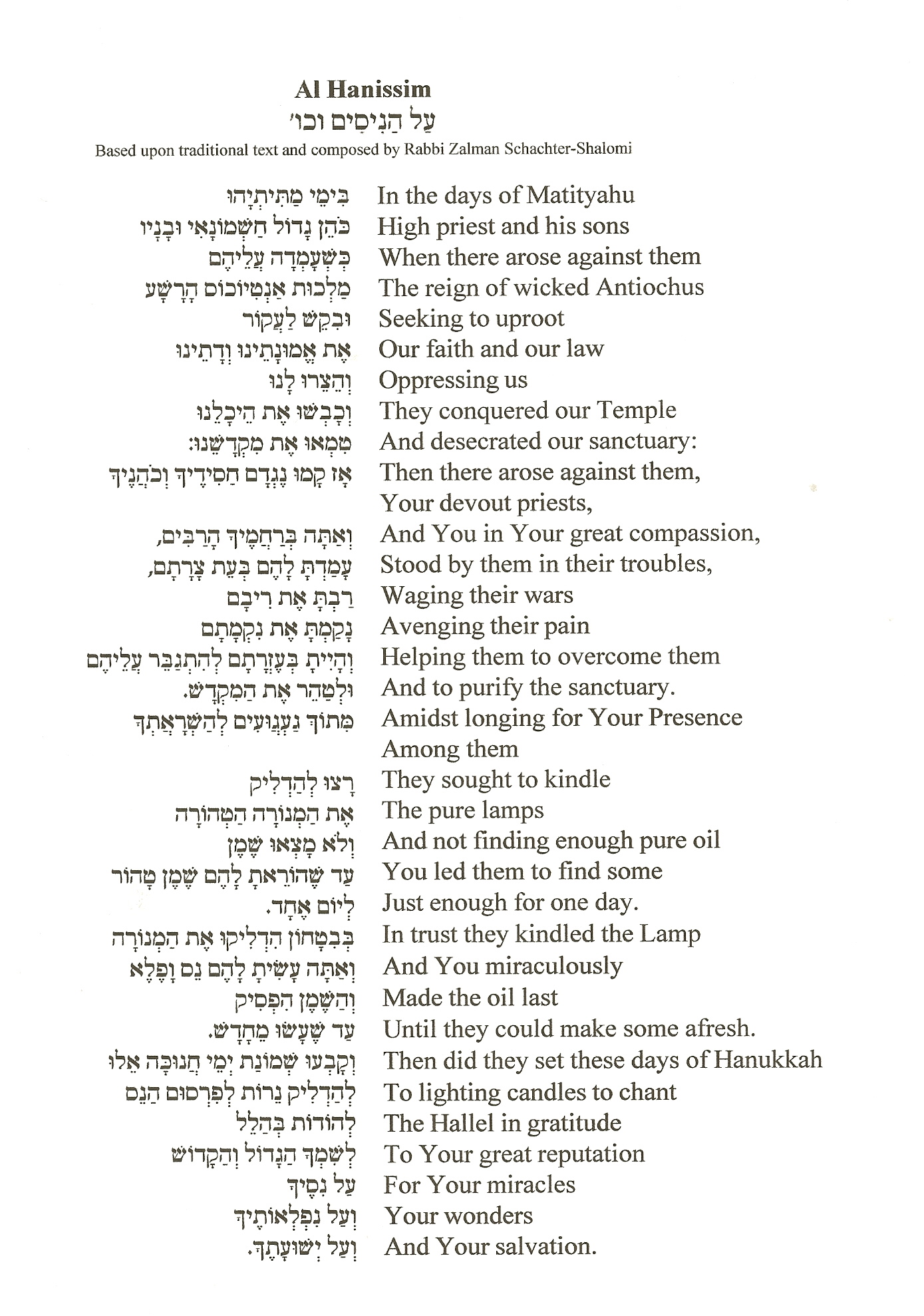
Based upon the traditional Hanukkah text which gets inserted into the tefillah / the eighteen benedictions and birkat hamazon / Grace After Meals, Reb Zalman has composed the following update, which can be used in its stead:

al_hanissim.jpg 

Happy HanukkahGabbai Seth Fishman (BLOG Editor)

Maoz Tzur

Sunday, November 25th, 2007

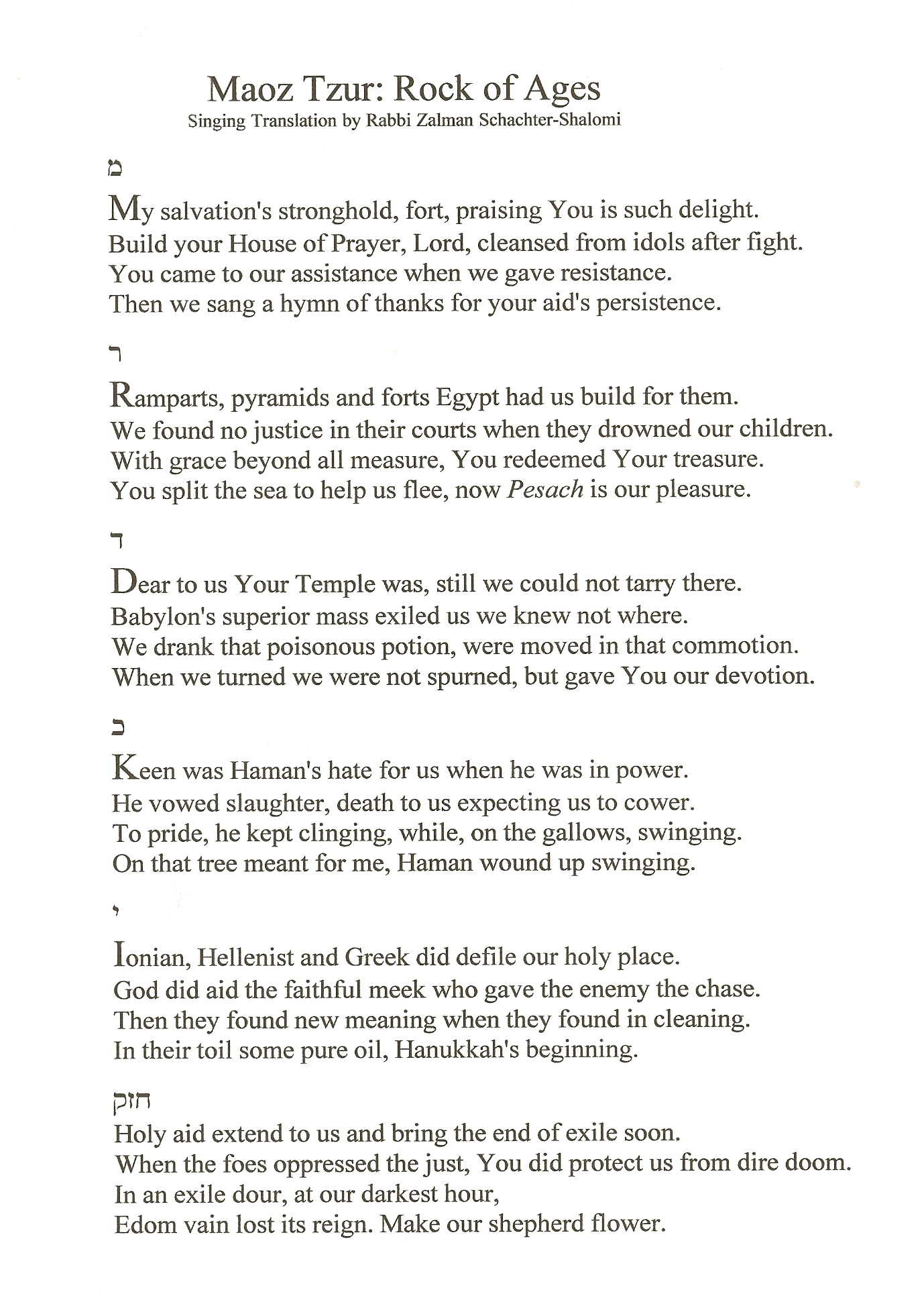
Please make use of Reb Zalman’s translation of Maoz Tzur which works with the traditional melody while adding a post-triumphalist slant to the original.   Happy HanukkahGabbai Seth Fishman (BLOG Editor)

maoz_tzur.jpg