Archive for the ‘Reb Zalman says’ Category

Haggadah: Telling and Empowering

Tuesday, April 8th, 2008

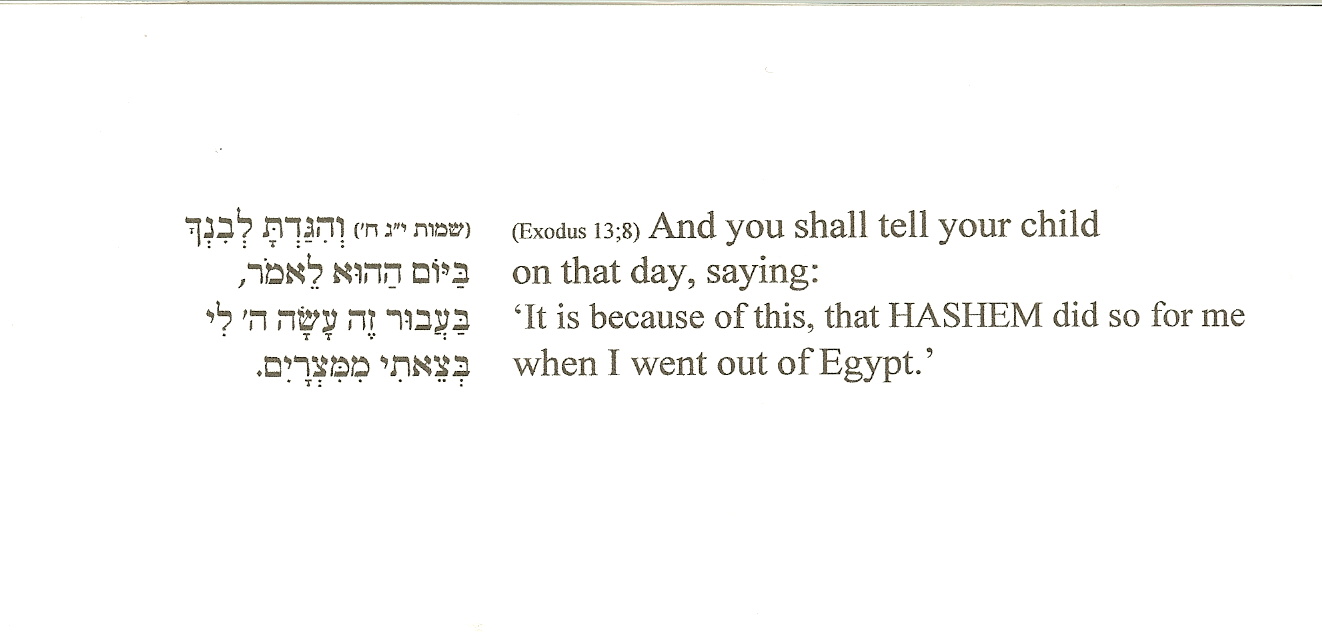
The following text is one of the four times the Torah asks us to be sure there is a telling of the Exodus from Egypt to our children. 

l-vincha.jpg

From the above text plus the three others, the Rabbis had the idea of Four Sons of the Haggadah

The Rabbis were Piscean New-Agers, and in those days, they read bin-cha as “your son.”  That’s how they understood it.  Instead of “your son,” we read it as “your child,” the Four Children

In Hebrew, the word “children” can be either Yeladim / young boys and girls, or Banim / offspring (of any age).   When the word bin-cha occurs in the Torah, the “children” refers to the latter usage, i.e., child of any age, offspring.  

It is also understood to mean the child within oneself. 

So at the Passover Seder, we must speak about Exile, Pessah, Deliverance, Faith and Healing with our sons, our daughters and the child within ourselves.

While the Seder speaks of four kinds of children, we can also say there are four kinds of parents who answer:  1) the body, 2) the feeling spirit, 3) the intellective soul, and 4) the intuitive God-spark in us.  What a blessing to give voice to all these four and to open these four in our children. 

(more…)

Reb Zalman On Conversion And Renewal

Wednesday, January 30th, 2008

Reb Zalman says: 

“As part of what I consider to be my ethical will and summation of my life, I want to bring to your attention my experience and thoughts on conversion. 

“We have always taken responsibility for conversion and we have always taken responsibility for our converts, not only with regard to this incarnation, but also regarding previous and subsequent incarnations.”

Please read the following words from Reb Zalman.  If you wish to add your thoughts, please do so in the comments section at the end.  Gabbai Seth Fishman, BLOG Editor.

B’nai Noach Within Our Communities:
Gerey Tzedek / Converts
And Gerey Toshav / Non-Converts

by Rabbi Zalman Schachter-Shalomi

Table of Contents:

Ger Tzedek or Ger Toshav?
Some Guidelines
Raise Expectations
Include A Klall Yisrael Perspective
Ensure Adequate Education and Preparation
Provide Supports
In The Case of Intermarriage
Neshamot / Souls
Holocaust
Jews In Passing
Hyphenation
Conclusion

(more…)

On Halachah and Jewish Renewal

Wednesday, December 5th, 2007

In each one of the following excerpts, Reb Zalman uses the same analogy:  How a spine grows in endo-skeletal vertebrates.  The analogy is used to illustrate Reb Zalman’s sense of how the essential structures of both Halachah / the way to be a Jew and Jewish Renewal are to be understood.  The essential structures are inside and they stay constant in a basic way while at the same time there is growth and change. 

Respectively, the excerpts are from Reb Zalman’s book, Integral Halachah: Transcending and Including, available from Aleph and an edited transcription of a video you can see by clicking here, posted on Rabbi Ayla Grafstein’s Youtube site.  Please share your comments on either or both excerpts and happy HanukkahGabbai Seth Fishman (BLOG Editor)

From Integral Halachah:

“Here is a wonderful, organic way of looking at the anchors of halachah / observance, what I’d call ‘the non-negotiables,’ ‘the absolutes:’   They are like the bones of an organism.   

“Look at the etymology for the Hebrew word atzmut / essence and atzmiut identity:  They both come from etzem / bone. 

“The essence of halachah is bone-like.  That feels right to me.  I see some present-day halachists as trying to protect themselves around with bones, as if the anchors were exo-skeletal. 

“We have to bring halachah inside so that we live with and have our skeleton on the inside and we have flesh, skin, etc., around it. 

“Deep inside are our absolutes, but around that we have to be able to grow, develop and change, which is like what is known as the chanoch la-na’ar / the education of the child. 

“Imagine that we decide to throw away the Maxwell House Haggadah so it speaks more to the concerns of the adults from our time.  How do we do this in such a way that it still speaks to the children and the adults, in such a way that as events change in the world from year to year it remains constant while it grows at the same time?  How do we give the children their connection and give each person his/her connection according to his/her phase in life so all can tune into it, yet it remains constant and recognizable? This is the genius of the seder, the genius in the way in which we have our edut, in the celebrative ways that we have.

(more…)

Accidental Oops-es of God?

Wednesday, November 28th, 2007

The following is from “For Arnold Jacob Wolf’s Festschrift” Gabbai Seth Fishman (BLOG Editor)

Reb Zalman says:

“In the early 1960’s, before I had fully realized I was a post-Triumphalist, I wrote a sliding scale concerning participation in other religions and Kashrut / degrees of permittedness from a Jewish perspective.

“For example, it had Sufism on the same level as eating a salad in a non Kosher restaurant served on a glass or paper plate and Satanism on the same level as eating pork on Yom Kippur. Non-iconic forms of Vedanta, Quakerism and Buddhism came out closer to the Kosher side, like a vegetable soup in regular china with non kosher flatware, while high iconic Christianity and Hinduism were more like eating non-kosher beef.  It was a pretty good attempt that still may have some mileage in it for triumphalist restorationists.

“Then and now, I believed in the workings of Divine Providence, in the way Hassidism teach it, Hashgachah pratit / a specific Divine Providence, one that ordains even how a leaf falls.

“So I had to also entertain the idea that this same Divine Providence had produced a Buddha, a Lao Tzu.

“Could I say that just as we consider our own Rebbes to be N’shamot Klaliyot / exalted souls encompassing the souls of many, that these were not the same?  Were they just accidental oops-es of God?

(more…)

Envisioning Success in Annapolis

Sunday, November 25th, 2007

From Reb Zalman: 

“It seems to me that all of us need to exert our hope and faith for the success of the negotiations in Annapolis this week.  We should hold the image of a Middle East that has healed from its deep wounds.  On both sides the narrative has to be changed radically. 

“The atavistic reinforcement of reptilian brain reactivity cannot be changed by the mere ‘rational’ cortex language, the type of language that will be used during that conference.  

“It is not likely that the shift will happen without a spiritual transparency to the will of God and the healing of the planet. 

“There’s a missing ingredient, not to be found in any discussions of the peace issue from either side.  That ingredient is the recognition of a benefit of having the other as neighbor.

“At the moment, the Palestinians in Gaza and the West Bank (also, Syria, Iran, Saudi Arabia, Egypt and Lebanon), do not seem to see any benefit in having the democratic state of Israel as a neighbor in their midst.  And Israel also does not seem to see a benefit of having an Arab/Muslim/Palestinian state as an intrinsic entity either.

“Until this vision is added added, the discussions will lack something crucial, negatively influencing the likelihood of a peaceful outcome. 

(more…)

The Ten-Planner

Thursday, November 8th, 2007

Reb Zalman says:

“I’ve worked on the design of a computer program for problem-solving, or planning, using the tradition of the sefirot / divine attributes as a methodology.  If the software is ever produced, it can be called, the ten-planner.  Here is a description of what it would look like:

“The program would systematically divide a problem into activities using the sefirot as a guide.  It would allocate intervals of time of differing duration for each activity and would do this through asking a series of questions. 

“First, it would ask keter / vision questions:  Keter questions help one to structure the time allocation for the subsequent phases to define where to spend the time.  Keter will create a balanced tree.

Chochmah / Brainstorming would ask:  ‘What do you want?’  The person would say, ‘I want x.’

Binah / Planning would say:  ‘Let’s figure out what x is.  What are all its dimensions?  What are its inputs?  What kind of planning goes into it?  What sort of a budget is needed?’  And Binah‘s answers would lead to computations and allocations.

“Da’at / Awareness would sneak in as quality control:  ‘How will we know we’ve achieved what we set out to achieve?  I, Da’at, am the feed-back loop.  When it doesn’t hit these indicators, I’ll tell you you’ve missed the mark.’

Chesed / Lovingkindness:  ‘What are my resources?  What’s available for spending in terms of time, space, energy, money, etc.?’

Gevurah / Discipline:  ‘What limits must I consider for time, space, energy, money, etc.?’

Tiferet / Balance:  ‘Who’s going to participate?’  (Tiferet has the social dimension.)

Netzach / Effectiveness, Efficiency:  ‘What kind of technology do I need to make it happen.  Who do I need with what expertise?’  (There’s a discussion between netzach and gevurahGevurah says, ‘Don’t forget your budget,’ while netzach wants to spend through the nose, so it will be super-duper good with insurance and everything built in.  Gevurah sends down a budget message, saying, ‘We can’t afford everything you want, netzach.’)

Hod / Impact:  ‘How am I going to get this idea to find space in peoples’ hearts?  How shall I market it?  How shall I package it?’

Yesod / reproducibility:  ‘How can I produce it so that today and tomorrow it can keep going and be nurtured.  I need a sustainable way.’

Malchut / Operations:  ‘Release the plan.  It has to function by itself, without being connected to the system which produced it.’

“The above, illustrates one way that we might try to apply the functions of the Sefirot in the world of Assiyah.”

Please share the ways in which you have integrated sefirot into your life.  Gabbai Seth Fishman, BLOG Editor.

On Prayer

Sunday, November 4th, 2007

Reb Zalman says (from “The Space Within” and “Integral Halachah: Transcending and Including” both available from Aleph): 

“When I ask myself, ‘What should I do?  Should I write some more finesses in Kabbalah or should I translate another piece of Siddur / prayerbook that people will need?’ And the answer is, I want to translate the Siddur instead.  

“How many people have Jewish names, Jewish ancestry and have no current connection to their Jewish spirituality.  And if they could, they would like to do a something, but it’s not the something that’s connected with shul, or with the people with the black hats and so on and so forth. 

“Imagine for a moment a picture drawn by Norman Rockwell, (Saturday Evening Post, you know?),  a Jewish family at the breakfast table all with their kippahs on, not yet eating because papa is saying, ‘Avraham.  You read us this chapter from the Psalms, or from the Scriptures beforehand,’ and then, ‘A little bit of the sedra today we are reading from rivii of this sedra.  Read that little stickele.’  And people discuss it at the table.  And then they make those prayers that they want to do for the day.  ‘I’m going to be writing a quiz today.’  ‘Yes.  Dear God, help Johnny to be able to write the quiz well.’  They pray around the table.  Can you imagine that?  

“I feel that that sense of the American Judaism hasn’t quite yet gotten the tools and so I felt that you had to do something with the freeze-dried stuff.  But I tried to already give you not just freeze dried but canned.  But you still have to warm it up yourself.  So in this way, if you will take the material and look at those words that are there:  ‘Dear God:  Just like my parents – you helped them to live life so they could serve your purpose – please help me also.’

“When you say it in this way, you don’t need any more stuff; you just need to have the feeling.  That’s why we go back to the focusing part.  If I can say it from the place where I’m  hurting, I can say it from the place where it’s real for me, then I don’t need to put more hot water in there.

(more…)

A Renewed Jewish Credo

Monday, October 22nd, 2007

The following is from Reb Zalman’s 1991 shiur "Renewal is Not Heresy" during which participants worked on envisioning a Judaism of the future.  The shiur is now available from Aleph under the title "Renewal Is Judaism Now."  Gabbai Seth Fishman, BLOG Editor Reb Zalman says:

"We have a consensus that, by and large, is tacit, not explicit.  And there is a process which fuels the consensus of who we are.  "The consensus has energy that wants the tikkun / the repair of broken things and it wants to bring these things about, the new possibilities of integration, and it wants to use whatever tools and magic it has to bring these things about.   "The agreements are formed very often by something like gossip.  There is a power-with situation that is governed by the "gossip’s" flow in a community.  And that gossip determines, to a large extent, what the consensus of the pious will be.  "The conventional wisdom underlying that consensus is taken for granted by the participants who are shaping the consensus.  There is a certain kind of agreement that floats in the air.  The agreement is the template of society.  It is a conventional wisdom through which the consensus is sort of programmed.  "Mordechai Kaplan helped us see that we are no longer operating with unconscious re-interpretation.  We are aware of what we are doing when we are doing it.   "For example, we do not tell ourselves that what Albert Einstein said is what Moishe Rabbeinu really meant when he taught us the Torah.  When we say that what Einstein said is what Moishe really meant, we add that this is a a drosh / an interpretation.  And reinterpretations happen for everyone as cosmologies change and they give us pause.   Because if our institutions don’t reflect the new cosmologies, then we are faced with a gap between our beliefs and our institutions. "I want to find out the consensus of our committed so that I can help accelerate the closing of this gap.  Rather than being implicit, I want to make the consensus of our commitment explicit. 

(NOTE:  Please share something of your implicit conventional wisdoms at the end of the article.  Gabbai Seth)

(more…)

Lead with the Heart

Tuesday, October 2nd, 2007

The following is an excerpt from “The Space Within” a four dvd set available from Aleph recorded at Elat Chayyim in 2004. Please respond with any comments.

Gabbai Seth Fishman (BLOG Editor)

Reb Zalman says:

“So the question now is, sometimes one hears it said that you need to lead with the mind, that the mind creates the emotions, and sometimes one hears that you need to lead with the heart, that the emotions create the awareness for the mind.

“And while, for instance in Chabad there has been the idea, ha-midos hen toldos chabad / the emotions descend from the mind, i.e. that you begin always with the mind first and then proceed into the feelings, that was from a time when the dream world of the hasidim was so rich. For example, one reads of those hasidim, ‘I dreamt it was pesach already.’ And, ‘I dreamt that on purim I dressed myself into such and such a costume,’ and the like.

“If you were to read some of the dreams that were recorded by Reb Nachman or by the grandson of the baal shem tov or by the komarner rebbe, you’d get a sense they had wonderful, wonderful dreams, because their dream world was alive.

“So if you had such a good dream world as they, such a good affect world, all you would need to do is to get started with the mind and then the rest of it follows. And that’s the context of ha-midos hen toldos chabad / the emotions descend from the mind. That’s the place from which to understand what they are saying with that phrase.

“However, we are not in that same situation. We have to do a lot of repair in our affect place.

“So for us it is better to go with Reb Avraham Yehoshua Heschel, the Apter Rebbe, who was teaching us, ‘v’hair lev v’sum sechel‘ / awaken the heart and then put your mind to it.

“And here’s how you can see that this is the better way to go. There is something buzzing in this area and it’s spilling over into all kinds of places.

“There is now a group in Boulder Creek, California called The Institute of HeartMath and they’re pointing out that if you have good memories, good images, that you can, at the moment when you have been upset, do ‘freeze-frame,’ (that is what they call it), and go into the heart place, and from there instead of coming up with a defensive notion, you will come up with something that is inclusive, that will work things out. It is so amazing.

“So today, it seems that what we need is to get into the feeling place and not rush from one level of feeling to another level of reactivity, that’s to say from pain to anger.

“And if you can imagine what it would be if we were to have a core of grandparents going to the West Bank, to Gaza and to Israel and sit with people who have lost grandchildren. And own the pain. And own the grief that’s going on.

“By not owning that, by not bringing it into the light, all the road maps to peace won’t work, because they are starting out in the cortex, they are starting out in the conceptual world, and they come onto a world that has been so activated not to own the grief, but to go into anger; on both sides.

“Can you understand why it’s going to be impossible to do it leading with the mind? The healing has to come by healing that feeling world. And the feeling world will also heal the physical body and it will also heal the politics.”
Reb Zalman, 2004, elat Chayyim