Archive for the ‘The Hasid Says’ Category

Gevurah time

Friday, April 17th, 2009

For me and others, Reb Zalman shows us ways to bring the Sefirot inside.  There are seven times seven days between the night of the second Seder and Shavuoth.   We count these days and weeks as follows:  Day 1 is chesed of chesed; day 49 is malchut of malchut.  In between, we go chesed of chesed, gevurah of chesed, tiferet of chesed, netzach of chesed, hod of chesed, yesod of chesed, malchut of chesed, chesed of gevurah, etc., through malchut of malchut

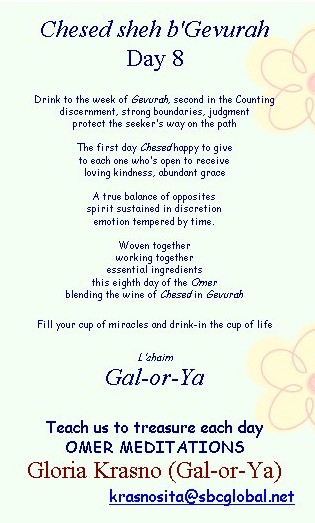
If this doesn’t mean anything to you, then a good place to begin is Chaplain Gloria Krasno’s meditations for Gevurah.  Enjoy!  Gabbai Seth Fishman, BLOG Editor

gevurah_day8.jpg

(more…)

A Week of Chesed

Sunday, April 12th, 2009

Dear Friends:  Chaplain Gloria Krasno sends the following meditations for this first week of counting the Omer.  Good Yom tovGabbai Seth Fishman, BLOG Editor

chesed_intro.jpg

(more…)

Shalom!

Wednesday, December 17th, 2008

shalom.jpg

Music for Sefirot

Wednesday, December 10th, 2008

Dear Friends:

Reb Zalman:  “I would love it if someone were to write these themes into a symphony in seven movements that we could use for the Simchat Torah dances.”   (From “Simchat Torah Processions”.)

The themes Reb Zalman references in this quote are those associated with each of the seven days of Sukkot and also with the seven processions of Simchas torah.  Each day and procession are associated with one of the seven sefirot / divine attributes:  Chesed / LovingKindness, Gevurah / Strict Justice and Discernment, Tiferet / Balance, Mercy and Harmony, Netzach / Persistence, Focus, Hod / Beauty and Aesthetics, Yesod / Foundation, Malchut / Kingship, Shechinah / divine in-dwelling, tikkun / repair and a healed planet.

When I first read Reb Zalman’s statement, I envisioned a ballet with seven movements based upon the composition.  Halevay / God-willing such a piece and such a production will come to fruition so we can all hear and see it!

Zalman has sometimes spoken of particular pieces of music that evoke associations in us of specific sefirot.  In this post, I have put together various recordings of classical music with such associations.  I brainstormed the list based upon my own understanding of Sefirot;  the list is a current snapshot of a subjective understanding and association with each Sefirah.

I hope you will find this useful in your connections to Sefirot and God.   Enjoy (click a composer’s name below to hear the music)!  Please place suggestions for music that you associate with Sefirot in the comments section, below.  Gabbai Seth Fishman, BLOG Editor

Music for Sefirot, 5769

Chesed:  Ravel: Pavanne, Barber: Adagio for strings, Tchaikovsky: Symphony 6, mvt 2Gershwin: Rhapsody in Blue (please ff to section from 5:34 to 7:42), DvorakSymphony 5Wolf:  “Schlafendes Jesuskind, Massenet: Meditation from ThaisTchaikovsky: Symphony 6, mvt 1 (please ff to section from 8:27 to end), Vaughan Williams: Fantasia on a Theme by Tallis, Vaughan Williams: Fantasia on Greensleeves, Brahms: “Wiegenlied, Wolf: “der Genesene an die Hoffnung.

(more…)

Forgiveness and Repentance

Wednesday, September 24th, 2008

Here are some thoughts on Selichos as a preparation for Rosh Hashanah.  Gabbai Seth Fishman, BLOG Editor

Forgiveness and Repentance
Teachings for Selichos Compiled from the teachings of Reb Zalman
By Gabbai Seth Fishman (BLOG Editor)

Table of Contents

Levels of Forgiveness
Baal Teshuvah / Penitent
Kapparah / Atonement
Baal Teshuvah and Tzaddik

Levels of Forgiveness

There’s a nice mashal / analogy Reb Zalman has used to help explain the different stages of forgiveness as related to transgressions, (from A Guide for Starting Your New Incarnation, pp. 77-78).  Reb Zalman:

“Imagine that, chalilah v’chas / God forbid, I have an automobile accident.  I run into someone else’s car.”

The car accident is the transgression we will look at.  Assume it was your fault the accident happened.

“I get out of my car to talk to the other person.  It was my fault, my negligence.  The guy is ready to shrey / yell at me, to call me names, to accuse me of being blind. 

“Before he can do that, I say to that person how sorry I am, that I beg his pardon and I apologize. 

“Then, I say, ‘Let me see what we need to do about it,’ and I admit it was my fault. 

When you said you were sorry, at that point, it was the first stage of forgiveness, selichah.  Though the other party may have accepted the apology,  on a certain feeling level, there is still annoyance.

(more…)

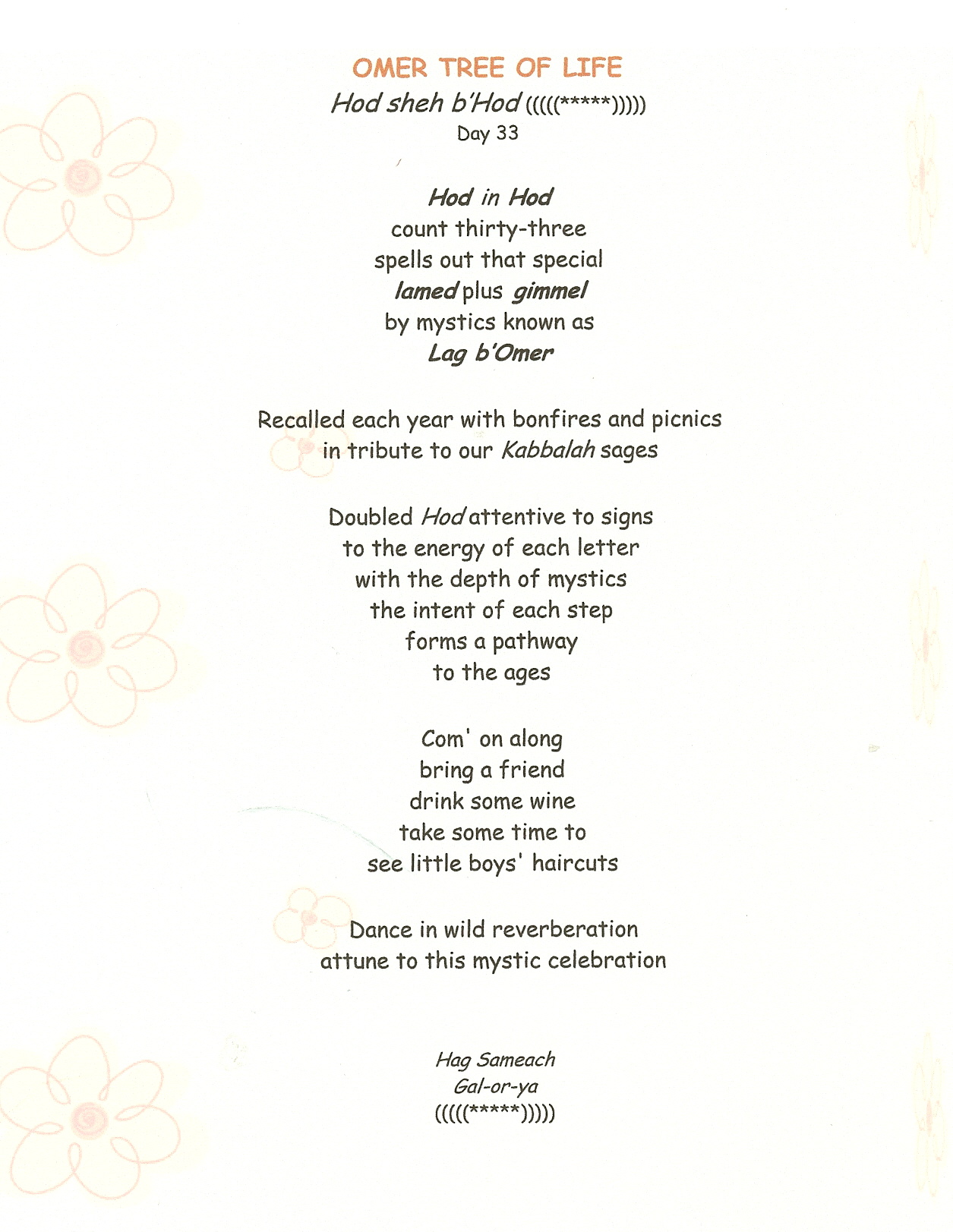
Day 33 Hod-Hod

Thursday, May 22nd, 2008