Patheos Interview
Sunday, November 22nd, 2009Reb Zalman talks about his journey of faith and exploration of other religious traditions in this interview with Patheos CEO and Founder, Leo Brunnick.
Don’t miss this sweet and wonderful talk.
Reb Zalman talks about his journey of faith and exploration of other religious traditions in this interview with Patheos CEO and Founder, Leo Brunnick.
Don’t miss this sweet and wonderful talk.
Dear Friends:
Thanksgiving is just about here.
Many of us will have a festive meal.
But the important part is that at this dinner we should invite some needy people so that we might feed them.
It is also important before Birkhat Hamazon, the grace after meals, to count our blessings and to give thanks to God.
Based on the model that we have for Hanukkah and Purim I have written an insert prayer to include both in the Amidah as well as in the Birkhat Hamazon and I offer this as a suggestion for your Thanksgiving celebration. (CLICK HERE FOR A COPY)
Blessings,
Reb Zalman Hiyyah Schachter-Shalomi
The following is a translation of Reb Zalman’s text “On Sukkot” from his Sefer, Yishmiru Daat. The Hebrew/English version is at the bottom. Chag Sameach, Gabbai Seth Fishman, BLOG Editor
And on Sukkot, the Sefirah of Tiferet lights up. Tiferet is associated with Yaakov, olav hashalom.
[The following is the scriptural basis for this association. Gabbai Seth]
(Genesis 33:17) “And for his cattle, he made Sukkot / booths.”
And the Supernal Guests visit us each of the seven days the Sukkah structure stands,
[Every night, a different guest as follows. Male: 1- Avraham (Chesed), 2- Yitzchak (Gevurah), 3- Yaakov (Tiferet), 4- Moshe (Netzach), 5- Aharon (Hod), 6- Yosef (Yesod), 7- David (Malchut). Female: 1- Miriam (Chesed), 2- Leah (Gevurah), 3- Hannah (Tiferet), 4- Rivka (Netzach), 5- Sarah (Hod), 6- Tamar (Yesod) and 7- Rachel (Malchut).]
as Yaakov grows up into Yisrael Saba, (Zohar I, 236).
[Yaakov was renamed to Yisrael. The term, Yisrael Saba / grandfather Israel, refers to that aspect of Chochmah which we can access. Chochmah is way at the top of the tree and has another aspect that is beyond our access. From the Baumann text: “Each and every partzuf / interface to God is divided into two levels… Partzuf Abba / father is divided into Chochmah and Yisrael Saba.” Think of Yisrael Saba as the exterior of the Sefirah of Chochmah.]
On each Yom Tov, a special light of meheimnusa / faith is shining. On Yom Kippur, it is erech apayim / slow to anger, patient, forgiving, atoning.
In the Yishmiru Daat DVD, Reb Zalman says:
And do you remember at Neilah / the locking of the gates (final section of the Yom Kippur service), instead of having the long Al Chet / enumeration of sins, it says, ata notein yad laposh’im / you extend a hand to transgressors. That sense of, (Psalm 73:22-23), “you have given me a hand.”
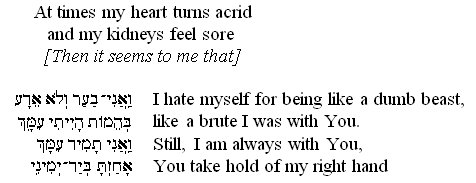
Please click here, to hear Reb Zalman sing the melody for this Psalm.
Dear Friends:
Every zeitgeist, every paradigm, has embedded a particular understanding of how things work. We draw upon our paradigms and emerging technologies because they effectively express what’s happening from our perspectives at a point in time. In the following piece, Reb Zalman uses the paradigm of the computer, to talk about The State of the Jewish Mythic World. He sends this as a meditation for Tish’ah B’av, (“How doth the city sit solitary that was full of people” – Eicha 1:1), which occurs this year on the evening of Wednesday, July 29th, 2009. Gabbai Seth Fishman, BLOG Editor
After the Hard Drive Crashed
Meditation: On The State Of The Jewish Mythic World
“After the Hard Drive Crashed”
by Rabbi Zalman Schachter-Shalomi
My hard drive and mother board crashed. If you ever experienced such a breakdown of this “extension of your memory,” the holder of your information, you will understand what I went through as my invisible, cyber, world support became inaccessible to me. It is a kind of computer-related depression and a grieving for the files I failed to back up, now forever lost. And as I remembered what I had lost, I set out to do whatever it would take to restore everything to the status quo ante quem so that my life would continue uninterrupted. And in these cases, we try to do just that.
Now imagine it was old DOS, or system 6 Mac that crashed, and as you pursue the restoration, you are told that a Pentium motherboard, a faster netsurfing modem, and the latest of Windows or newer Mac OS are available; that in fact, you can improve your situation by building a new, broader platform for your information base.
Before you upgrade, you will first have to satisfy concerns about whether the new system will be able to handle the old software applications you will need to re-establish and whether the back-ups and restores will be able to help you work your backed up information back in. In other words, while you are interested in using the best you can get together at this time, your new system has to be downward compatible.
Speaking of time: In the time dimension, after a computer crash, I am tapping into the workaholic in me, and I am devastated because of time commitments. The frustration blocks everything but frantic casting around and my desire to get it all fixed and back to where it had been.
But now, Shabbat comes and, I realize I can’t do anything about it. So for the next 48 hours, I must make a shift. As I get in touch with dimensions of time and beyond the market-place, work-place mentality, I suddenly become aware of this as a gestalt of my weekday calamity, and I awaken to a perspective of this situation in a larger field.
I enter into the world of the Mashal Haqadmoni / the mythic world, the Primal Myth, (cf., Rashi on Exodus 21:13), I begin musing on Jewish History and on mythic dimensions that hold our world together and allow the sparks of kabbalistic light to illumine the field.
Here is what arose for me:
The following is a transcription of Reb Zalman speaking at the recent Shavuot retreat. Please scroll to the bottom for a copy of Reb Zalman’s singing translation of Yedid Nefesh. Gabbai Seth Fishman, BLOG Editor.
“The last few years, I’ve felt that it is important to draw back from leadership so that I can really put my energy in highlighting what’s most critical:
“In terms of the innovations we’ve made in the Jewish services, we are doing good Friday nights. ‘We give good Friday night.’ People come and they dance and it’s freilach and they love each other and ‘v’ahavta l’rayacha kamocha’ / love thy neighbor as thyself and Shema Yisroel / Hear Oh Israel. And we did pretty good with Shabbos morning, because everywhere, little by little, the notion of not calling up the ‘Mr. Goldberg-s,’ i.e., the ones who would give a big donation to the shul, (he gets this aliyah and this one gets that aliyah), has been replaced by saying to people, ‘We’re going to read in the torah about such and such a thing. Do you feel this deep? Then you come up to the torah here.’ So we’ve done something remarkable with shabbos morning too.
“What we haven’t yet done well is shalosh seudos. This means the Shabbos afternoon time. Also, I’m still worried about us not doing enough weekday davvenen.
Rabbi Ayla Grafstein (http://www.youtube.com/jewishrenewal) and others have been putting snippets of Reb Zalman on YouTube. Here is a current index of what you will find. Gabbai Seth Fishman, BLOG Editor
Last week, I was one of the hundred plus participants at the wonderful Shavuot retreat at Isabella Freedman (Elat Chayyim). At the closing circle, a question was posed by another attendee:
I’ve transcribed Reb Zalman’s response below. Gabbai Seth Fishman, BLOG Editor
In the booklet called “Gate to the Heart,” I make the following point (cf., Stages of the Path, pp 6-8):
When a person first gets caught in “Oy! How wonderful it is to be a Jew,” they are in the land of “Milk and Honey.” This is like the Oral Phase in Freud’s Psychosexual Stages of Development, (NOTE: Referred to as the Rung of Love in “Gate to the Heart”). “Oy is it good, geshmak / delicious, it’s beautiful.”
And after a while, following the Freudian model, the progression has their Judaism moving to the Anal Phase, which is to say, “Now I need to learn some discipline,” (NOTE: Referred to as the Rung of Power in “Gate to the Heart”).
But if someone doesn’t want to move on, saying, “I don’t want to go for a practice with discipline, I want to go back to the original belief that I had,” then they are like one fixated on the Oral Phase. And if they get fixated on the Oral Phase, they will go from guru to guru and from system to system and say, “Because I love to be ‘love-bombed’ by the people to whom I come and bring my soul and they love me and I feel good, I will stay here.” And so, they will be going in this kind of incestuous way from one place to another trying to recapture the good feelings of the Oral Phase.
Here’s a translation of Reb Zalman’s writings on Lag BaOmer from his Sefer Yishmiru Da-at. The original text in Hebrew and English plus some background are provided below. Gabbai Seth Fishman, BLOG Editor
Lag BaOmer
excerpt from Yishmiru Daat
by Rabbi Zalman Schachter-ShalomiLag baOmer – is Hod sheb’Hod / splendor of splendor (in the accounting of Sefirah).
(Genesis 32:25) “And he touched the hollow of his thigh and the hollow of Jacob’s thigh was sprained, etc.,” which was [the thigh of] the left leg, Hod / splendor, (cf., Pardes Rimonim Shaar 17 ch. 1).
And the one who wrestled, i.e., Esau’s guardian angel, had not wanted Jacob, (who is Tiferet / majestic beauty, presence, mercy), to feel his own beauty (yafyo), and his attack was intended to diminish his esteem, as though he had no Hod / splendor whatsoever. And one who is smitten like this may think that s/he has no chen / grace, Hod / splendor or yofi / beauty, but rather, s/he may think s/he is ugly.
However, when a perceived external reality appears to indicate some turn for the worse in one’s grace, one may nonetheless feel, at core, that one is in Hod sheb’Hod / splendor of splendors; one may yet feel this at a time when one’s inside, innermost places cannot access a shemen sasson / oil of gladness meant to revitalize oneself when one loses one’s sense of chen / grace. For this reason, we pray when we count the Omer on Lag BaOmer: “May it be Your will… that in the merit of the Omer count that I have counted today, that there be corrected whatever blemish I have caused in the Sefirah Hod she-b’Hod,” i.e. those times when within one’s innermost places one feels a sense of ugliness.
In this article, originally published in “New Menorah,” Reb Zalman takes us from that moment in our Seders when we will eat the Afikoman, to the opening of the door for Elijah the prophet, and beyond. Please consider these suggestions for your Pesach celebrations. (Gabbai Seth Fishman, BLOG Editor)
When we read through the section of the Hagadah that deals with the Wise Child, the way the response is written implies that one is to give the Wise one all kinds of instructions in Halakhah because of hir having asked an excellent and intelligent question. And one such Halakhah, singled out in the text is the laws of Afikoman. Specifically, it states: After having finished eating the Afikoman, one may not follow this with any dessert. This seemingly trivial law must be taught to the one who is wise.
In the time of the Holy Temple, the afikoman rule meant that after having eaten the Paschal Lamb, one was not to refresh one’s palate with anything else; the taste of the Paschal Lamb was to linger.
In our day, too, although we are no longer able to offer the sacrifice in animal form, the commentators say that we are to have the taste of the matzah, the Afikoman food of our time, linger with us for the rest of the night. The only other taste in which we can still partake at that point of the Seder is the wine in the cups that are to follow; and especially that of the cup of Elijah.
Now I want to talk about these two points in the Passover Seder, (afikoman; Elijah’s cup), and I want to first draw upon something we have learned from Reb Arthur Waskow. Reb Arthur points out a way we can understand the image of the fringes at the corners, the tzitzit, which occur in many laws in the Torah. There are subtle extensions as a mitzvah injects itself into the fabric of our lives and Reb Arthur has described this as the tzitzit. So, I’d like to bring to mind this image, as we continue to look at the way that the lingering taste of the mitzvah of the afikoman extends.