Archive for the ‘Calendar’ Category

How to Develop Your God-Connections

Tuesday, October 27th, 2009

The following text by Reb Zalman is for this week’s Torah portion, Shabbos Lech Lecha.  (Click here for Hebrew/English version).  [Notes by Gabbai Seth Fishman, BLOG Editor]:

“Go out … to the land I will show you” (Genesis 12:1). 

And, indeed, there is, at times, some influence that will make some faint impression upon us.

[Note:  An impression, or an inspiration.  We are being asked to relate this text to those experiences we have had as interactions with the divine, or God-connections.  Gabbai Seth]

Just as when someone snaps a picture, and until the film is developed, the picture can’t be seen, and not even if the camera is opened to the light at which time the faint impression is destroyed. 

For this reason, Hashem Yisborach said to him:  “Leave your land,” and this is like the developer, “your birthplace” – stop bath, “your father’s house” – fixer, “to the land that I will show you,” and later (ibid 18:1) “and Havaye appeared to him in Elone Mamre,” i.e., Hashem became visible.

[Note:  For photos, the developer converts the latent image to metallic silver, the stop bath is a solution to set the proper contrast and the fixer makes the image permanent. 

In order to take hold of the inspiration, to get it clear, to internalize it, we must sort through our root metaphors so that our connection to the source of all being will become clear and strong.  Like Abraham, the root metaphors which we have when we enter adulthood come from influences of country (artzecha), an indigenous culture (moladiticha) or religion (beis avicha).]
(more…)

Creation: Something We Can Work With

Thursday, October 15th, 2009

The following text by Reb Zalman is for this week’s Torah portion, Shabbos Bereishis.  (Click here for Hebrew/English version):

“Asher bara elokim laasot / Which God, in creating, had made,” (Genesis 2:3).

Hashem Yisbarach / God, may S/He be blessed, deals with the level of Beriah / creation (creatio ex nihilo / creation out of nothing), and we deal with the level of Assiyah, making something out of what was already created.

And since the world of Assiyah is for our use,

[Assiyah is the name for the world of action.  The others are the worlds of feeling-Yetzirah, mind-Beriyah and spirit-Atzilut.  Gabbai Seth]

and since it was designated as such, God, Yisborach / may S/He be blessed, is both surprised and  delighted from the new things that we bring about.

(more…)

On Sukkot: Surrounded and Filled with Faith

Thursday, October 1st, 2009

The following is a translation of Reb Zalman’s text “On Sukkot” from his Sefer, Yishmiru Daat.  The Hebrew/English version is at the bottom.  Chag Sameach, Gabbai Seth Fishman, BLOG Editor

And on Sukkot, the Sefirah of Tiferet lights up.  Tiferet is associated with Yaakov, olav hashalom.

[The following is the scriptural basis for this association.  Gabbai Seth]

(Genesis 33:17) “And for his cattle, he made Sukkot / booths.” 

And the Supernal Guests visit us each of the seven days the Sukkah structure stands,

[Every night, a different guest as follows.  Male:  1- Avraham (Chesed), 2- Yitzchak (Gevurah), 3- Yaakov (Tiferet), 4- Moshe (Netzach), 5- Aharon (Hod), 6- Yosef (Yesod), 7- David (Malchut).  Female:  1- Miriam (Chesed), 2- Leah (Gevurah), 3- Hannah (Tiferet), 4- Rivka (Netzach), 5- Sarah (Hod), 6- Tamar (Yesod) and 7- Rachel (Malchut).]

as Yaakov grows up into Yisrael Saba, (Zohar I, 236).

[Yaakov was renamed to Yisrael.  The term, Yisrael Saba / grandfather Israel, refers to that aspect of Chochmah which we can access.  Chochmah is way at the top of the tree and has another aspect that is beyond our access.  From the Baumann text:  “Each and every partzuf / interface to God is divided into two levels…  Partzuf Abba / father is divided into Chochmah and Yisrael Saba.”  Think of Yisrael Saba as the exterior of the Sefirah of Chochmah.]

(more…)

Yom Kippur / Keter Elyon

Wednesday, September 23rd, 2009

On each Yom Tov, a special light of meheimnusa / faith is shining.  On Yom Kippur, it is erech apayim / slow to anger, patient, forgiving, atoning. 

In the Yishmiru Daat DVD, Reb Zalman says:

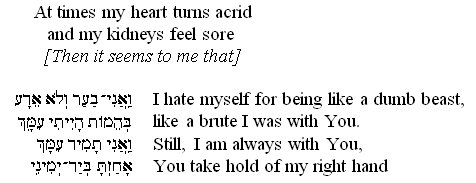
And do you remember at Neilah / the locking of the gates (final section of the Yom Kippur service), instead of having the long Al Chet / enumeration of sins, it says, ata notein yad laposh’im / you extend a hand to transgressors.  That sense of, (Psalm 73:22-23), “you have given me a hand.”

ps_73.jpg

Please click here, to hear Reb Zalman sing the melody for this Psalm.

(more…)

On Rosh Hashanah

Sunday, September 13th, 2009

In the mapping of the Holidays and the Sefirot, Rosh Hashanah‘s two days correspond to Chochmah and Binah.  The following is a translation of Reb Zalman’s text for Rosh Hashanah from Yishmiru Daat.  You will find the Hebrew at the end of this post.  Blessings to you.  Gabbai Seth Fishman, BLOG Editor

And on Day One of Rosh Hashanah, God makes possible for us an opportunity to tap into energies of “Beginning” and Chochmah / Flash of insight so one can start afresh.  And on Day Two, the opportunity to tap into energies of fifty gates of Binah / practical plans for the above flash and Teshuvah / realignment with God, with the Supernal Mother Who is the source of loving-kindness, and the lady of Forgiveness. 

(more…)

Toward Consciousness and Goodness

Friday, July 31st, 2009

Dear Friends:

Gal-Or-Ya provides us with beautiful meditations for our journey from Tisha B’Av to erev Rosh HaShannah, Sefirat HaBinyan / a reckoning toward more conscious and appropriate living.  Thank you, Chaplain Gloria Krasno!  Good Shabbos, Gabbai Seth Fishman, BLOG Editor

malchut_day1.jpg

(more…)

Dirge For Auschwitz

Tuesday, July 28th, 2009

As Reb Zalman writes in his book, Paradigm Shift, (pp. 68-69), “We have yet to attend to the Holocaust liturgically, with only a few notable exceptions…  I have written a Hebrew version of a lamentation prayer (kinah) on Auschwitz in the style of the medieval kinot, with an English rendition.  Both can be chanted to the melody of Eli Zion V’areha.”  Please consider including Reb Zalman’s “Dirge for Auschwitz” in your Tisha B’Av ritual.  Gabbai Seth Fishman, BLOG Editor

DOWNLOAD ENGLISH VERSION

DOWNLOAD HEBREW VERSION

aus_dirge1.jpg

(more…)

Reb Zalman’s Offerings Through Aleph Store

Tuesday, July 28th, 2009

The ALEPH Canada Web Site, https://www.alephcanada.ca/catalogue, offers Reb Zalman’s books, CD’s and DVD’s as digital downloads. Prices are in Canadian dollars.

Here is the current listing:

* Credo of a Modern Kabbalist (with Daniel Siegel) ($18)

* An English Siddur for Weekdays (temporarily unavailable)

* First Steps to a New Jewish Spirit (with Donald Gropman) (available from Amazon)

* Gate to the Heart: An Evolving Process (edited by Robert Esformes) (available from Amazon)

(more…)

For Tisha B’av: After the Hard Drive Crashed

Friday, July 10th, 2009

Dear Friends:
Every zeitgeist, every paradigm, has embedded a particular understanding of how things work.  We draw upon our paradigms and emerging technologies because they effectively express what’s happening from our perspectives at a point in time.  In the following piece, Reb Zalman uses the paradigm of the computer, to talk about The State of the Jewish Mythic World.  He sends this as a meditation for Tish’ah B’av, (“How doth the city sit solitary that was full of people” – Eicha 1:1), which occurs this year on the evening of Wednesday, July 29th, 2009.  Gabbai Seth Fishman, BLOG Editor

After the Hard Drive Crashed
Meditation:  On The State Of The Jewish Mythic World
“After the Hard Drive Crashed”
 by Rabbi Zalman Schachter-Shalomi

My hard drive and mother board crashed. If you ever experienced such a breakdown of this “extension of your memory,” the holder of your information, you will understand what I went through as my invisible, cyber, world support became inaccessible to me.  It is a kind of computer-related depression and a grieving for the files I failed to back up, now forever lost. And as I remembered what I had lost, I set out to do whatever it would take to restore everything to the status quo ante quem so that my life would continue uninterrupted. And in these cases, we try to do just that.

Now imagine it was old DOS, or system 6 Mac that crashed, and as you pursue the restoration, you are told that a Pentium motherboard, a faster netsurfing modem, and the latest of Windows or newer Mac OS are available; that in fact, you can improve your situation by building a new, broader platform for your information base. 

Before you upgrade, you will first have to satisfy concerns about whether the new system will be able to handle the old software applications you will need to re-establish and whether the back-ups and restores will be able to help you work your backed up information back in. In other words, while you are interested in using the best you can get together at this time, your new system has to be downward compatible.

Speaking of time:  In the time dimension, after a computer crash, I am tapping into the workaholic in me, and I am devastated because of time commitments. The frustration blocks everything but frantic casting around and my desire to get it all fixed and back to where it had been.

But now, Shabbat comes and, I realize I can’t do anything about it.  So for the next 48 hours, I must make a shift.  As I get in touch with dimensions of time and beyond the market-place, work-place mentality, I suddenly become aware of this as a gestalt of my weekday calamity, and I awaken to a perspective of this situation in a larger field.

I enter into the world of the Mashal Haqadmoni / the mythic world, the Primal Myth, (cf., Rashi on Exodus 21:13),  I begin musing on Jewish History and on mythic dimensions that hold our world together and allow the sparks of kabbalistic light to illumine the field. 

Here is what arose for me:

(more…)

Shalosh Seudos Time and Weekday Davvenen

Thursday, June 25th, 2009

The following is a transcription of Reb Zalman speaking at the recent Shavuot retreat.  Please scroll to the bottom for a copy of Reb Zalman’s singing translation of Yedid Nefesh.  Gabbai Seth Fishman, BLOG Editor. 

“The last few years, I’ve felt that it is important to draw back from leadership so that I can really put my energy in highlighting what’s most critical: 

“In terms of the innovations we’ve made in the Jewish services, we are doing good Friday nights.  ‘We give good Friday night.’  People come and they dance and it’s freilach and they love each other and ‘v’ahavta l’rayacha kamocha’ / love thy neighbor as thyself and Shema Yisroel / Hear Oh Israel.  And we did pretty good with Shabbos morning, because everywhere, little by little, the notion of not calling up the ‘Mr. Goldberg-s,’ i.e., the ones who would give a big donation to the shul, (he gets this aliyah and this one gets that aliyah), has been replaced by saying to people, ‘We’re going to read in the torah about such and such a thing.  Do you feel this deep?  Then you come up to the torah here.’   So we’ve done something remarkable with shabbos morning too. 

“What we haven’t yet done well is shalosh seudos.  This means the Shabbos afternoon time.  Also, I’m still worried about us not doing enough weekday davvenen.

(more…)